
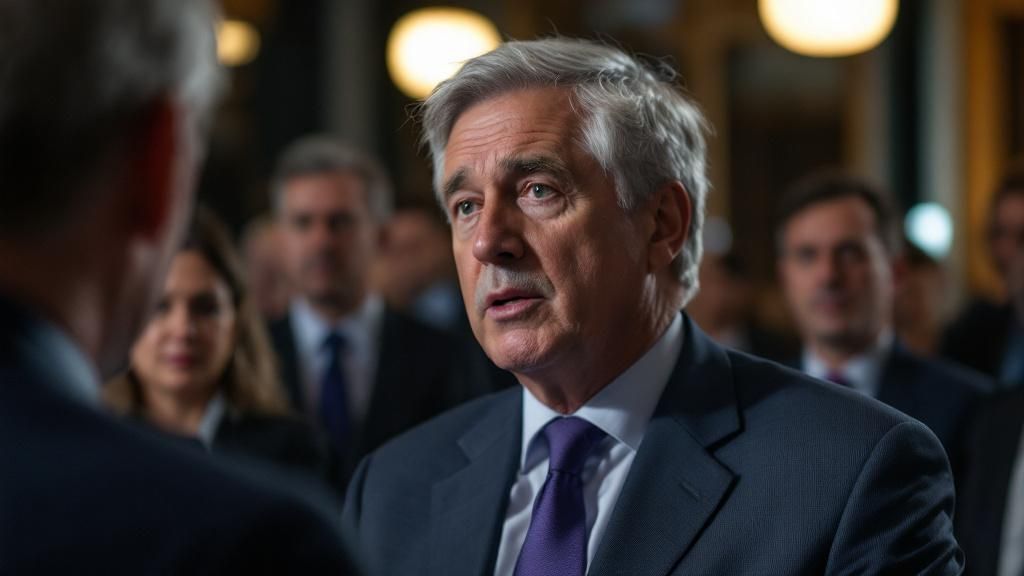
As families throughout the country grapple with soaring energy bills and inflation hitting record levels, the opposition figurehead has initiated a scathing attack on the Government’s handling to the cost of living crisis. In a tense Commons clash, the Labour party has scrutinised the government’s inadequate support measures, demanding more meaningful intervention to help struggling families. This article analyses the mounting political tensions centred on the crisis and investigates the contrasting proposals for financial support.
The Opposition’s Critique of Government Policy
The leader of the opposition has increased pressure of the government’s response to the worsening affordability crisis, asserting that present interventions fall woefully short of addressing the scale of hardship affecting UK families. During parliamentary exchanges, the opposition has articulated a detailed critique encompassing insufficient financial assistance, inadequate action in energy markets, and a perceived lack of urgency in tackling inflation. The opposition contends that whilst households grapple with unprecedented bills, the government’s piecemeal approach only addresses surface issues rather than addressing root causes of economic hardship.
Central to the opposition’s position is the assertion that the government has badly miscalculated both the scale and length of the crisis. Opposition representatives have pointed to figures showing that millions of people now face genuine hardship, with many forced to choose between warmth and food. The opposition argues that the government’s first response underestimated the crisis’s consequences, leading to assistance programmes that proved inadequate when the situation got worse further. This error of judgment, they argue, reflects wider shortcomings in economic forecasting and preparedness.
Limited Support Systems
The opposition has directly criticised government support schemes as lacking in scope and precision, arguing that energy price cap mechanisms fall short of protecting at-risk groups sufficiently. Critics point out that whilst the government has introduced multiple support measures, such as grants and council tax rebates, such provisions offer short-term assistance without resolving systemic issues. The opposition argues that eligibility-based assistance remain overly stringent, leaving out millions of families in work who nonetheless struggle with mounting expenses. In addition, they argue the government’s approach falls short of the ambition required to tackle such an extraordinary financial crisis.
Opposition examination indicates that current support mechanisms negatively impact middle-income households who fall between eligibility thresholds for means-tested support. The party has outlined alternative frameworks incorporating unconditional income transfers, expanded welfare provisions, and public sector action in power industries to stabilise prices. They emphasise that interim steps, albeit positive, cannot substitute for fundamental systemic change. The opposition contends that without substantial legislative change and greater state spending, working people will continue experiencing acute financial strain in the coming period.
Long-term Economic Strategy Concerns
Beyond urgent crisis response, the opposition has posed key questions regarding the state’s long-term economic direction and competitive position. Opposition analysts argue that the present method prioritises near-term political appearances over long-term economic sustainability, risking damage to Britain’s future economic wellbeing. They contend that without strategic investment in renewable energy systems, industrial capacity, and skills development, the nation risks prolonged economic stagnation. The opposition underscores that managing cost of living difficulties requires wide-ranging reforms targeting productive efficiency, creative advancement, and industry development alongside urgent relief measures.
The opposition has articulated concerns that government policy lacks consistency across different areas, with energy policy, industrial strategy, and fiscal measures operating in isolation rather than as coordinated elements. Critics argue this disjointed strategy impedes tackling of core inflationary challenges and fundamental economic problems. The opposition calls for a unified national approach including energy transition, manufacturing revival, and skills development. They maintain that real problem-solving necessitates radical policy overhaul rather than incremental adjustments to existing frameworks.
Government’s Response and Counter-arguments
The government has firmly defended its fiscal approach, arguing that the living cost challenges are primarily driven by worldwide circumstances beyond Westminster’s immediate reach. Ministers have highlighted the extraordinary scale of the energy shortage, stemming from international tensions and worldwide supply chain interruptions. They maintain that their tailored support schemes, encompassing the price cap on energy and living cost payments, represent a prudent and financially sound approach. The Finance Ministry maintains that excessive spending could worsen inflation even more, compromising sustained economic stability and eventually harming the identical households the opposition purports to support.
Government spokespersons have emphasised the substantial financial assistance currently in place, totalling billions of pounds in immediate aid to vulnerable households. They maintain that their policies balance immediate relief with prudent fiscal management, averting the debt spiral that uncontrolled expenditure could trigger. Ministers also draw attention to their work in boosting energy security through renewable investments and supply diversification. The government asserts that whilst the opposition offers sympathetic rhetoric, their suggested policies lack financial viability and would create unsustainable outcomes without raising tax rates or greater public borrowing.
Furthermore, state representatives highlight their dedication to tackling core economic problems through efficiency enhancements and corporate investment encouragement. They argue that lasting economic recovery demands systemic economic transformation rather than immediate financial relief. The executive branch considers this method ultimately delivers increased wealth and protection for the entire population.
